
Ask ten people what a timesheet is and several will describe a punch clock card. Ask what a time card is and someone will describe a spreadsheet their consultant fills in on Fridays. The words have been swapped so often that even employers mix them in handbooks. Underneath the confusion sit two genuinely different tools, built for two different questions. A time card answers "exactly when was this person working?" A timesheet answers "how much time went where?"
That difference sounds small until money or an audit leans on it. Pay for an hourly worker is built from minutes, and minutes only survive in a time-card style record. Billing for a client project is built from hours assigned to tasks, which is what a timesheet is for. Using the wrong one for the job is how businesses end up with records that prove nothing.
What a time card is
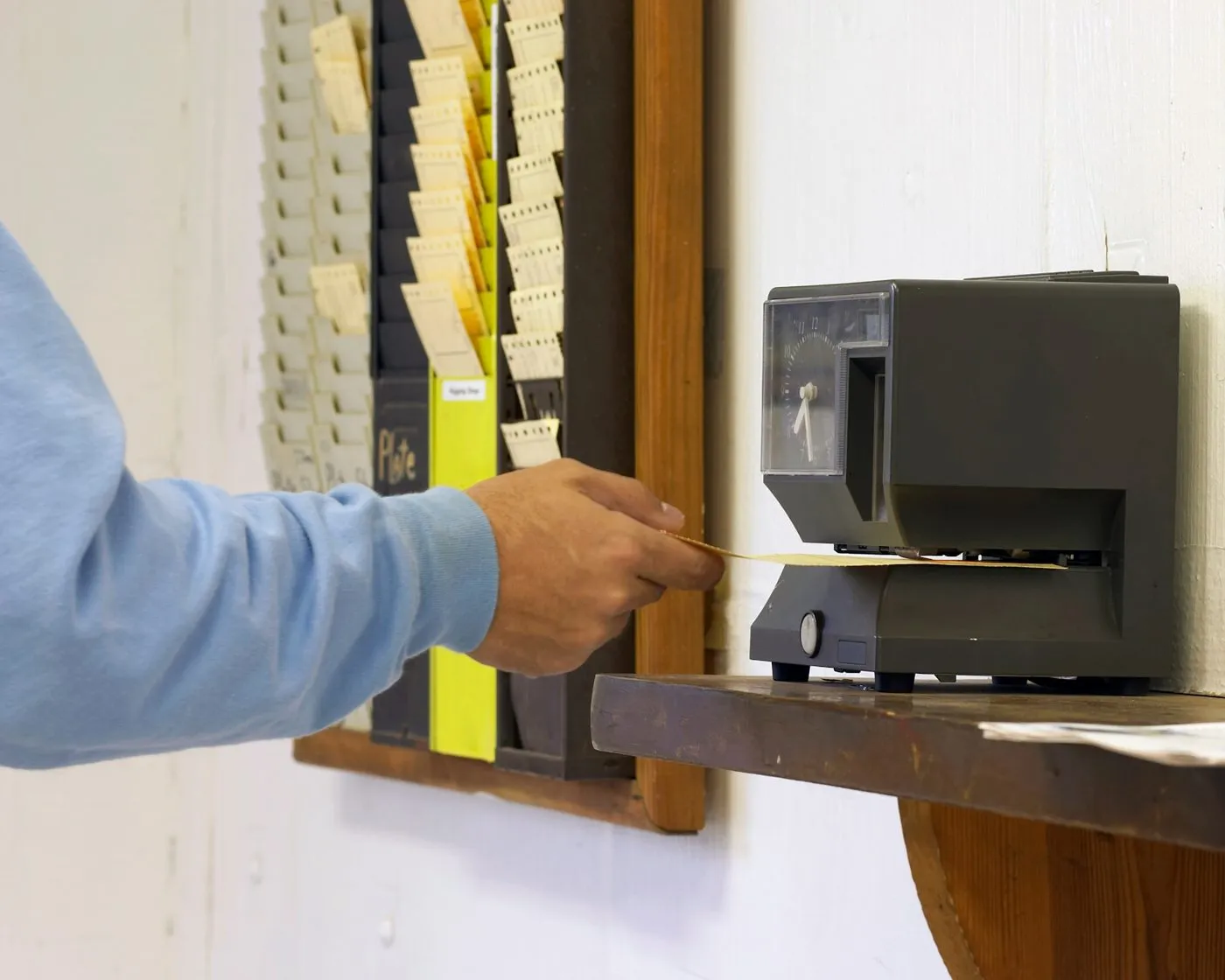
A time card is a record of exact clock times. Traditionally it was a stiff paper card that a wall clock stamped when you arrived, went to lunch, came back and left; today it is just as often a digital record from a clock terminal, a badge tap or an app. Either way, the entries are the same: precise times, captured at the moment they happen, four punches on a typical day. The card itself does no thinking. Its job is to be evidence - the raw material from which hours, overtime and pay are calculated later.
Because the times are exact, everything downstream can be checked. If a paycheck is questioned, the card is what both sides go back to. That is also why time cards belong to hourly work: when pay is literally priced by the minute, the record has to be made of minutes. Everything payroll later builds from the card - day totals, the week total, the overtime split, gross pay - is arithmetic on those exact times, which is precisely the job our time card calculator does from the same four punches a day.
What a timesheet is
A timesheet is a record of hours, usually filled in by the worker, usually after the fact, and very often divided by what the time was spent on. A consultant's timesheet says Monday held 3 hours for one client, 2 for another and 3 on internal work. A salaried engineer's timesheet splits the week across project codes. Nobody punches anything; the sheet is commonly completed at the end of the day or the end of the week, in rounded blocks of 15 minutes, 30 minutes or whole hours.
The timesheet's purpose is allocation, not attendance. It exists so a business can bill clients, cost jobs, track project budgets and satisfy grant or contract reporting. The worker's pay often does not depend on it at all - a salaried employee is paid the same whether the sheet says 38 or 41 hours - which is exactly why timesheets are allowed to be approximate in a way time cards are not.
Side by side
| Question | Time card | Timesheet |
|---|---|---|
| What it records | Exact start, lunch and stop times | Hours worked, often split by task or client |
| When it is filled in | At the moment, by a clock or tap | Later, by the worker, from memory or notes |
| Precision | To the minute | Rounded blocks - 15, 30 or 60 minutes |
| Main purpose | Calculating pay and overtime | Billing, job costing and project tracking |
| Typical users | Hourly staff in retail, care, warehouses, kitchens | Salaried staff, consultants, agency and project teams |
| If it is wrong | The paycheck is wrong | The invoice or project cost is wrong |
Read the last row twice. It explains the different levels of care the two documents get. A timesheet that is out by half an hour misstates a project's cost. A time card that is out by half an hour takes half an hour of pay from a person, repeatedly, every week it goes unnoticed - which is why the law's record-keeping demands land on the time-card side.
Why the two words got mixed up
Partly history: the paper card lived in a rack next to the clock, while the timesheet was the office summary the wages clerk built from those cards - so the words grew up in the same room. Partly software: modern apps do both jobs at once, recording exact punches and then presenting them as a weekly sheet, and vendors name the whole thing whichever word their buyers search for. And partly habit: in many workplaces there is only one document, and people call it whatever their first employer called it.
The honest position is that the boundary is now genuinely blurry in digital tools. What has not blurred is the underlying choice: do you need the exact minutes, or the allocation of hours? Name that need and the right record follows.
Which one your workplace uses - and why it matters to you
If you are hourly, your employer's clock records are a time card whatever the app calls them, and you should treat them that way: check the punches, not just the totals, and keep your own copies. If your workplace asks you to submit a weekly sheet of hours with no punches behind it, understand what that means - the record of your work is now your own handwriting, reconstructed on Friday, and it will be believed or doubted as handwriting. In that setup, daily notes are not fussiness; they are your only evidence.
Whichever record your job uses, the totals still have to be right, and you can verify them yourself. Our time card calculator works from exact punches - the time-card method - and produces the day totals, week total, overtime split and gross pay that payroll should arrive at. Run your week through it and compare with the sheet you are asked to sign; where the two disagree, the exact-punch method is the one that can show its working. For quick checks of a single span, the time calculator on the homepage does the same for one-off sums.
Frequently asked questions
Can the words time card and timesheet be used interchangeably?
People do it all the time, and in casual conversation it rarely matters. But the documents are built differently: a time card records exact clock times, while a timesheet records hours worked, often split by task or client. When accuracy or an audit is involved, the difference stops being casual.
Which is more accurate, a time card or a timesheet?
A time card, because it captures the actual minute of each start, stop and lunch, usually stamped by a clock at the moment it happens. A timesheet is typically filled in later from memory or notes, in rounded blocks, so it depends entirely on how honestly and carefully it is completed.
Why do salaried employees fill in timesheets if they are not paid by the hour?
Because the timesheet is not for their pay - it is for the business. Agencies, law firms, consultancies and grant-funded projects need to know where the hours went so they can bill clients, cost projects and prove how funded time was spent. The hours feed invoices, not paychecks.
Is a spreadsheet a time card or a timesheet?
It depends on what is typed into it. A sheet where you enter exact in and out times and let formulas total them behaves like a time card. A sheet where you enter hours per day against projects behaves like a timesheet. The tool is the same; the kind of record is decided by the entries.
Which is better for a small business?
For hourly staff whose pay depends on minutes, a time-card style record is safer because it preserves the exact punches behind every total. Many small businesses run a hybrid: time cards for hourly crews, timesheets for salaried or project staff, and both feeding the same payroll.
Johnson Ramzan builds and maintains every calculator on Time Calculator Tools himself, and he tests each one against worked examples he has done by hand before it is allowed near a reader. His guides follow US Department of Labor guidance on hours worked, overtime and rounding, and he writes them the way he would want a payslip explained to him: plain English, real numbers, and no step skipped. When a reader writes in with a shift pattern the tools handle badly, fixing it goes to the top of his list.
Last updated: October 29, 2026
Related guides
How to Fill Out a Time Card, Step by Step
Every box on the card explained, with a full week filled in correctly and the small mistakes that delay pay.
Read the guidePrintable Time Card Templates - How to Use Them Properly
How to pick, fill and total a paper template, and the ink-and-initials rules that keep a card valid.
Read the guideHow Punch Clock Times Become Payroll Hours
Follow one punch through rounding, lunch deductions and decimal conversion all the way to the number on your pay stub.
Read the guidePaper Time Cards vs Digital Time Cards
What each format does better, where each one fails, and how to choose for a team of any size.
Read the guide