
Start with a fact that surprises many people: federal law does not require your employer to give you a lunch break at all. The Fair Labor Standards Act is silent on meal breaks for adult workers; the requirement, where it exists, comes from state law or company policy. What federal law does govern, carefully, is pay. If a meal break is given, the question of whether it may be unpaid is answered by the rules at 29 CFR 785.19, and those rules are stricter than most break rooms realize.
The federal test for an unpaid lunch
A meal break can be unpaid only when it is a bona fide meal period, which means two things. First, length: ordinarily at least 30 minutes. A shorter break can occasionally qualify in special circumstances, but 30 minutes is the working standard, and anything under about 20 minutes is never a meal period at all. Second, and more important, freedom: the employee must be completely relieved of duty. Not mostly relieved. Not relieved unless it gets busy. Eating at your post while watching the door, answering the phone, or monitoring a machine is work, and the time is paid, sandwich or no sandwich.
Short rest breaks sit in a different box entirely. Under 29 CFR 785.18, breaks of roughly 5 to 20 minutes - coffee, restroom, a stretch - are paid time. An employer who punches staff out for every 15-minute break is deducting paid time, and across a team and a year that becomes one of the largest quiet errors in payroll.
How the break should appear on the card
The honest record of a real lunch is two punches: out when the break starts, in when it ends. A card that reads in 8:00 AM, lunch out 12:00 PM, lunch in 12:30 PM, out 4:30 PM tells the whole story at a glance. The day total is the span, 8 hours 30 minutes, minus the 30-minute lunch: 8 paid hours. Anyone - employee, payroll, investigator - can verify it in seconds, which is exactly what a good record is for.
Contrast the two shortcuts. A card with only in and out punches plus a flat "30 min lunch" written by habit proves nothing about whether a break happened. And the automatic deduction - software or a time clock that removes 30 minutes from every day by default - proves even less, while creating a specific risk: on the day the employee worked straight through, the record now shows a break that never occurred, created by the employer's own system. Investigators know this pattern well, because it features in case after case of unpaid-hours claims.
The practical rule for both sides: punches for real breaks, and a written note for exceptions. "Worked through lunch - truck unload" on Tuesday's row, initialed by a supervisor, converts a future dispute into a settled fact.
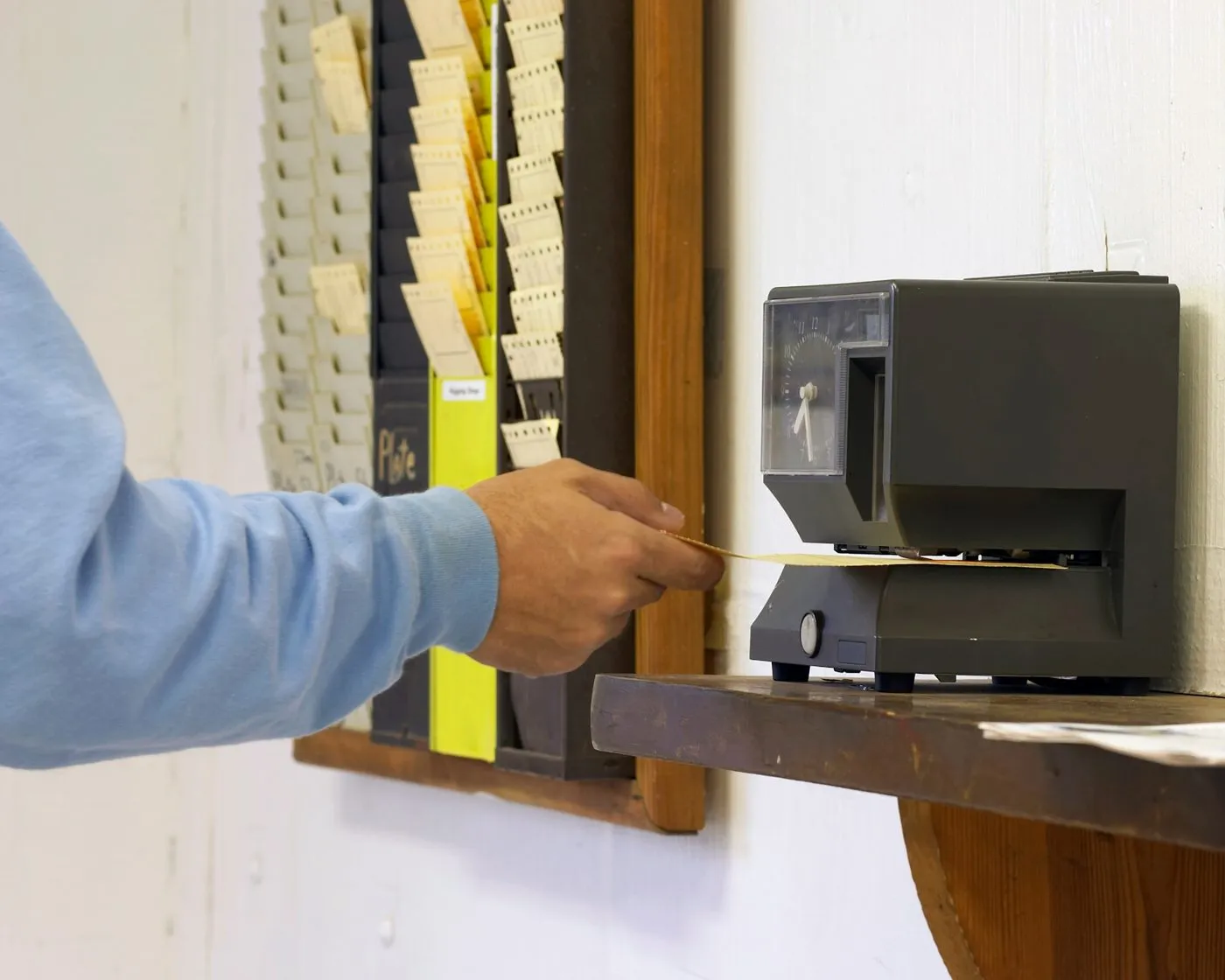
Worked example: a week with one worked-through lunch
Rosa works 8:00 AM to 4:30 PM at $15 an hour, with a 30-minute unpaid lunch. Monday, Tuesday, Thursday and Friday go normally: 8.5-hour span minus 0.5 lunch is 8 paid hours each, 32 hours. Wednesday the delivery schedule collapses and she works straight through, eating at the counter between customers, with her supervisor's knowledge. Wednesday is 8.5 paid hours - no deduction, because no break occurred.
Her week: 40.5 hours. Pay: 40 hours at $15 is $600, plus half an hour of overtime at $22.50 is $11.25, total $611.25. Now watch what the auto-deduction does to the same week: it removes Wednesday's phantom lunch, the week becomes 40 hours flat, the overtime vanishes, and Rosa is paid $600. One fictional break cost $11.25 and, repeated weekly, would cost about $585 across a year - and hand the employer a records problem worth far more than that.
You can reproduce this in the time card calculator: enter Wednesday with no lunch punches and the other days with them, and the totals show the same 40.5 hours and the overtime split. It is the fastest way to demonstrate, to yourself or to payroll, exactly what a lunch entry is worth on a given week.
State law: where breaks are actually required
Because the federal government does not mandate meal breaks, the states stepped in unevenly. California requires a 30-minute meal break on shifts over five hours (with a second on long shifts) and paid 10-minute rest breaks, with premium pay when breaks are missed. Washington, Oregon, Colorado and a number of others have their own meal and rest rules, each with its own timing and waiver details. Many states have no meal break law for adults at all, leaving it to employer policy. Two consequences follow: know your own state's rule before assuming either way, and remember that where state and federal rules differ, the one more favorable to the employee generally governs.
What to do when the deduction does not match reality
If your card or stub shows lunch deductions for breaks you did not take, fix the record first and argue second. Note the worked-through days on the card the same day, get them initialed, and keep your own dated log. Then raise it with payroll as a specific correction - the day, the deduction, the note on the card - rather than a general complaint. Employers with auto-deduction systems are usually required, in effect, to have a way for employees to report exceptions; if yours claims there is no way, that is worth a call to your state labor agency.
And if you are the employer reading this: the cheapest compliance tool in this entire area is the lunch punch. Real out and in punches, an exceptions habit, and a weekly glance before payroll - the routine in our guide on calculating time card hours with lunch - will keep your cards honest in both directions. The time calculator on the homepage handles the quick span-minus-lunch sums when a single day needs checking.
Frequently asked questions
Does federal law require employers to give lunch breaks?
No. The FLSA does not require meal or rest breaks for adult workers. Break requirements come from state law - many states mandate a meal break on longer shifts - and from company policy. Federal law only governs whether a break, once given, must be paid.
When can a lunch break be unpaid?
When it is a genuine meal period: typically at least 30 minutes, during which the employee is completely relieved of duty - not answering phones, not watching the counter, not on call for tasks. If the employee does any real work during it, the time is paid work time.
My employer auto-deducts 30 minutes even when I work through lunch. Is that allowed?
An automatic deduction policy is allowed, but the pay must still reflect reality. If you worked through lunch and the employer knew or should have known, those minutes are owed. The practical fix is to report worked-through lunches the same day and note them on the card, so the deduction is reversed with a record behind it.
Are short coffee breaks paid?
Yes, under federal rules. Rest breaks of about 5 to 20 minutes are paid work time - they are too short to be a meal period, and employers may not punch you out for them or deduct them from the day.
What if my lunch keeps getting interrupted?
Interruptions matter. If you are called back to work repeatedly, or the break is spent on duty tasks, the meal period stops being bona fide and the time becomes payable. Keep a note of interruptions on the card - dates and minutes - because the pattern, not one bad day, is what payroll and investigators look at.
Johnson Ramzan builds and maintains every calculator on Time Calculator Tools himself, and he tests each one against worked examples he has done by hand before it is allowed near a reader. His guides follow US Department of Labor guidance on hours worked, overtime and rounding, and he writes them the way he would want a payslip explained to him: plain English, real numbers, and no step skipped. When a reader writes in with a shift pattern the tools handle badly, fixing it goes to the top of his list.
Last updated: October 31, 2026
Related guides
How to Calculate Time Card Hours With Lunch
The arithmetic of the lunch deduction, day by day, with examples for the shifts people actually work.
Read the guideTime Card Laws: What Employers Must Record
The federal recordkeeping framework behind the lunch rules - and every other box on the card.
Read the guideCommon Time Card Errors That Cost You Money
The phantom lunch is error number one. See the other five quiet leaks and what each one costs per year.
Read the guideHow to Use Printable Time Card Templates
A good template has lunch out and lunch in columns built in. How to pick and use one properly.
Read the guide