
Decimal hours exist for one unglamorous reason: money. Pay is hours multiplied by a rate, and you cannot multiply a colon. 8:37 times $16 an hour is not a calculation; 8.62 times $16 is - it gives $137.92 in one step. So every payroll system quietly converts your minutes into a decimal before it pays you, and then prints the decimal on your stub, where it collides with the way your brain reads numbers after a decimal point.
That collision is the whole difficulty. On a clock, the part after the separator counts to 60. In a decimal, it counts to 100. Once you see the conversion as just swapping one counting system for the other, decimal hours stop being a code and become what they are: your minutes, expressed as a slice of an hour.
The one conversion you need
Minutes become decimal by dividing by 60. That is the entire formula:
Decimal hours = hours + (minutes divided by 60)
Work the example from the top of this guide. 8 hours 37 minutes: 37 divided by 60 is 0.6166, which payroll rounds to 0.62. So 8:37 becomes 8.62 hours. Run it backwards to check any stub figure: take the part after the point and multiply by 60. 0.62 x 60 = 37.2 minutes - your 37 minutes, with the small difference coming from rounding to two places. If the back-conversion lands within a minute of your card, the stub is honest.
That two-way check is the practical skill. You do not need to convert fluently in your head; you need to be able to verify, in ten seconds, that the decimal on the stub is the same length of time as the minutes on your card.
The conversion chart worth memorizing
Most real-world minutes cluster on a few values. Learn these and you can read most cards at a glance:
| Minutes | Decimal | Minutes | Decimal |
|---|---|---|---|
| 5 | 0.08 | 35 | 0.58 |
| 10 | 0.17 | 40 | 0.67 |
| 15 | 0.25 | 45 | 0.75 |
| 20 | 0.33 | 50 | 0.83 |
| 25 | 0.42 | 55 | 0.92 |
| 30 | 0.50 | 60 | 1.00 |
The quarter hours are the anchors: 15 is .25, 30 is .50, 45 is .75. Everything else sits between them. Notice the pattern in the chart - the decimals climb in a rhythm (0.08, 0.17, 0.25, 0.33...) because each 5 minutes is a twelfth of an hour. And burn this into memory: the decimal never means what it looks like as minutes. 0.60 on a stub is 36 minutes, not 60, and 0.75 is 45 minutes, not 75.
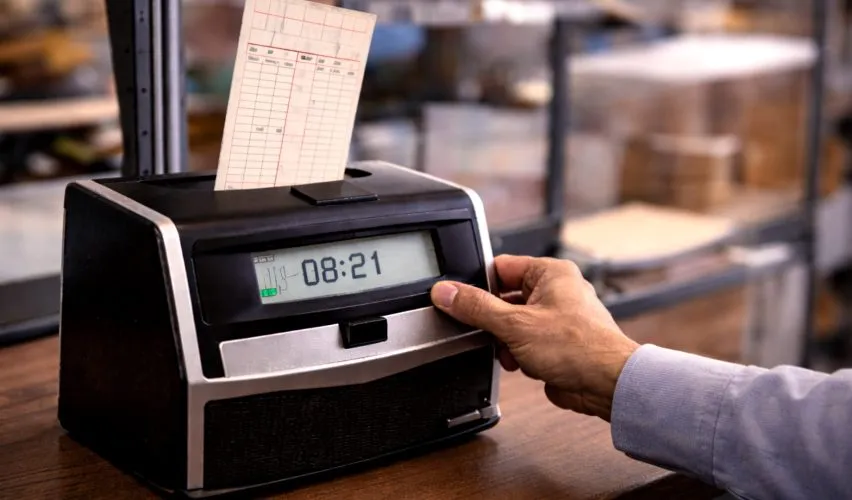
Reading a real card, line by line
Here is a week the way payroll sees it. The card on the left is minutes; the stub on the right is decimal; the conversion is the divide-by-60 step applied to each day. You can check any row of your own week against our time card calculator, which prints every total in both formats at once:
| Day | Card (hours:minutes) | Stub (decimal) | The working |
|---|---|---|---|
| Monday | 8:37 | 8.62 | 37 / 60 = 0.62 |
| Tuesday | 8:30 | 8.50 | 30 / 60 = 0.50 |
| Wednesday | 8:12 | 8.20 | 12 / 60 = 0.20 |
| Thursday | 9:05 | 9.08 | 5 / 60 = 0.08 |
| Friday | 7:48 | 7.80 | 48 / 60 = 0.80 |
| Week total: 42:12 | 42.20 | 12 / 60 = 0.20 | |
Two things to notice. Wednesday's 8:12 becomes 8.20, which looks like it grew - it did not; 0.20 of an hour is exactly 12 minutes. And Thursday's 9:05 becomes 9.08, a number that begs to be misread as 9 hours 8 minutes. It is 9 hours 5 minutes. The decimal is not a clock reading and never pretends to be; it is a fraction wearing a clock's clothes.
The 7.45 trap
Now the trap in the title. You see 7.45 hours on a stub and your brain supplies "7 hours 45 minutes", because 45 is a number that belongs after a colon. But 0.45 x 60 = 27, so 7.45 hours is really 7 hours 27 minutes. The misreading overstates the time by 18 minutes. It cuts the other way too: a genuine 7 hours 45 minutes converts to 7.75, and an employee expecting to see "7.45" may think the stub shorted them when it did not.
This one misunderstanding is behind a surprising share of payroll arguments, in both directions. Before you query a stub, run the back-conversion. Before payroll dismisses a query, they should too. Our time card calculator shows every total in both formats side by side - hours and minutes, and decimal - so you can hold the two versions of the same week next to each other and watch them agree.
Going the other way: decimal back to minutes
Sometimes the stub is all you have and the card is gone. To rebuild minutes from a decimal, split the number at the point. The whole part is hours. Multiply the decimal part by 60 and round to the nearest minute. 41.83 hours becomes 41 hours and 0.83 x 60 = 49.8, so 41 hours 50 minutes. Small rounding dust is normal: two-decimal decimals are precise to about half a minute, so a rebuilt total can sit a minute either side of the original card without anything being wrong.
If precision matters - a disputed week, a final paycheck - ask payroll for the punch record rather than rebuilding from decimals. The punches are the source; the decimal is a translation, and translations lose a little at the edges. And for the quick conversions while you work, the time calculator on the homepage handles the adding and subtracting; pair it with the divide-by-60 rule and you can follow any figure on any stub.
Frequently asked questions
Is 8.5 hours the same as 8 hours 50 minutes?
No. 8.5 hours is 8 hours 30 minutes. The .5 is half of an hour, not 50 minutes. To check any decimal, multiply the part after the point by 60: 0.5 x 60 = 30 minutes. Reading .5 as 50 minutes is the single most common decimal mistake on a pay stub.
Why does payroll use decimal hours instead of minutes?
Because pay is a multiplication: hours times rate. You cannot multiply 8:37 by $16 in one step, but you can multiply 8.62 by $16. Decimal hours are simply the format that lets the money calculation happen, which is why every payroll system converts minutes before it pays.
What is 45 minutes in decimal hours?
0.75. Divide the minutes by 60: 45 divided by 60 is 0.75, three quarters of an hour. The quarter-hour steps are the ones worth memorizing: 15 minutes is 0.25, 30 is 0.50, 45 is 0.75.
How many decimal places should hours be shown to?
Two places is the payroll standard, and it is precise to about half a minute: 0.01 of an hour is 36 seconds. One place (tenths) steps in 6-minute chunks, which is fine for rough tracking but too coarse for pay on its own.
Does rounding happen before or after the decimal conversion?
Either order exists in the real world. Some employers round the punches to the nearest quarter hour first, then convert - every decimal then ends in .00, .25, .50 or .75. Others convert exact minutes and round only the final figure to two places, which produces values like 8.62. Your pay stub format usually tells you which system your employer runs.
Johnson Ramzan builds and maintains every calculator on Time Calculator Tools himself, and he tests each one against worked examples he has done by hand before it is allowed near a reader. His guides follow US Department of Labor guidance on hours worked, overtime and rounding, and he writes them the way he would want a payslip explained to him: plain English, real numbers, and no step skipped. When a reader writes in with a shift pattern the tools handle badly, fixing it goes to the top of his list.
Last updated: October 29, 2026
Related guides
How to Build a Time Card Calculator in Excel
The exact formulas for daily totals, lunch, decimal hours, overtime and gross pay - and the errors everyone hits first.
Read the guideHow to Fill Out a Time Card, Step by Step
Every box on the card explained, with a full week filled in correctly and the small mistakes that delay pay.
Read the guideTime Card Rounding Rules Employers Use
The 7-minute rule, nearest-15 rounding, and what the law requires - so you can tell fair rounding from rounding that only ever goes one way.
Read the guideHow Punch Clock Times Become Payroll Hours
Follow one punch through rounding, lunch deductions and decimal conversion all the way to the number on your pay stub.
Read the guide