
Biweekly is the most common pay rhythm in the United States: 26 paychecks a year, each covering two workweeks. It feels natural to treat the card as a single 80-hour block - add everything, see if it passed 80, done. That natural instinct is also the most expensive misunderstanding in hourly pay, because the overtime rule was never written about pay periods. It was written about the workweek, one at a time.
Once you hold that one fact - two weeks on the card, two separate overtime tests - the rest of the biweekly calculation is just careful adding. Here is the method, then the numbers.
The rule that does not change: overtime is weekly
Under the federal Fair Labor Standards Act, a non-exempt employee earns overtime at time and a half for every hour past 40 in a workweek - a fixed, repeating block of seven days that your employer sets, often Sunday to Saturday or Monday to Sunday. The pay period is an accounting choice that sits on top of the workweeks. It can be a week, two weeks, or a month; the overtime test still runs inside each workweek separately.
That means a biweekly card must be totaled in three passes, not one. Total week one and split it at 40. Total week two and split it at 40. Then combine the pieces. Any method that starts by adding the two weeks together has already thrown away the information the law cares about.
A full two-week example, done right and done wrong
Meet a worker at $18 an hour. Week one is busy: 44 hours. Week two is quiet: 36 hours. The card totals 80 hours, and here is where the two methods part company.
| Week 1 | Week 2 | Period | |
|---|---|---|---|
| Total hours | 44 | 36 | 80 |
| Regular hours | 40 | 36 | 76 |
| Overtime hours | 4 | 0 | 4 |
The right way: 76 regular hours x $18 = $1,368. Overtime: 4 hours x $27 = $108. Gross pay $1,476.
The wrong way - the way the 80-hour instinct calculates it: the period never passed 80, so no overtime, and 80 x $18 = $1,440. The worker loses $36, and the loss is invisible, because the total hours on the stub look perfectly correct. Nobody stole anything dramatically; the week boundary was simply ignored. Multiply that quiet error across a year of uneven weeks and it becomes one of the largest sums an hourly worker can lose without ever seeing a wrong number.
Run your own two weeks through our time card calculator with the biweekly setting and it applies the weekly split automatically - enter all fourteen days and it tests each week against its own 40-hour line before combining them, which is exactly the discipline a paper card demands from you.
How to lay out a biweekly card
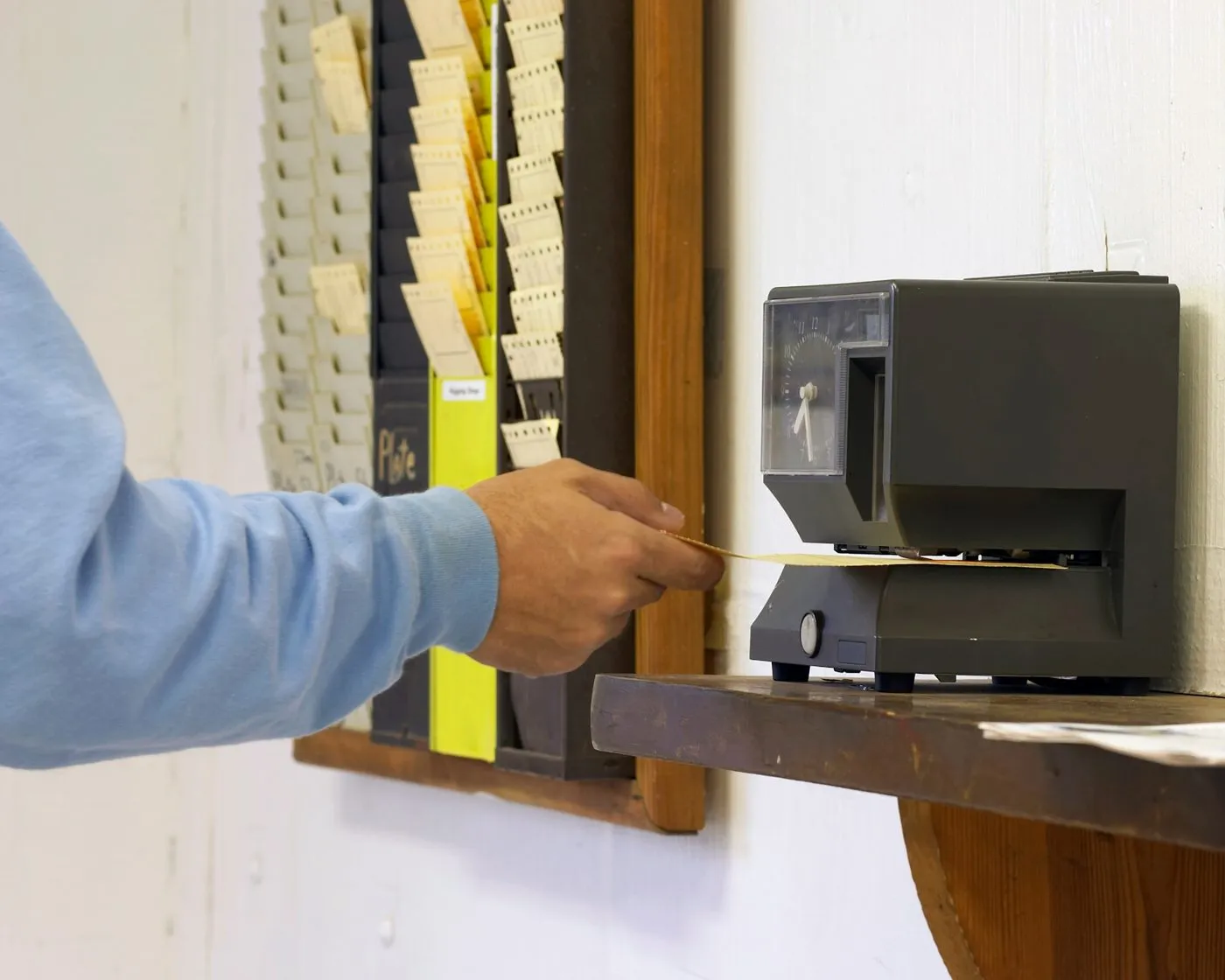
Whether your card is one long sheet or two weekly cards stapled together, it needs three features. First, a visible week subtotal line after day seven - the moment where each week is closed and tested against 40. Second, a regular/overtime split for each week, written before the period totals, so the split exists even if someone later re-adds the card wrongly. Third, the period summary: total regular hours, total overtime hours, and the two rates, kept separate all the way to gross pay. If a card or stub ever shows you a single blended rate for a period that contained overtime, something has been averaged that should not have been.
Day-to-day, the card works exactly like a weekly one: four punches, lunch off, day total before you leave. The biweekly part is purely in the totaling, which is why the subtotal habit matters - it is much easier to split a week correctly on day seven than to reconstruct the split on day fourteen.
The biweekly mistakes that cost money
Averaging is the big one, already covered. Close behind is carrying hours over: a manager notices week one ran long and sends the worker home early in week two "to balance it out". Leaving early is fine; treating those week-two hours as if they erase week-one overtime is not - the overtime was earned in week one and stays owed. Then there is boundary confusion: a workweek that ends mid-period is still one week, and a new workweek that starts before payday still belongs to its own period count. Finally, the calendar quirk: biweekly pay produces two months a year with three paychecks, which surprises people who budget as if biweekly meant twice a month. It does not - 26 periods is not 24.
Every one of these is caught by the same habit: never accept a period total you cannot break back into two weekly totals. If the weekly numbers exist and each passed its own 40-hour test, the period number is trustworthy. If they do not exist, build them - from your punches, with the time card calculator or by hand - before you accept the total. The time calculator on the homepage handles the quick single-week sums while you do it.
Frequently asked questions
Is overtime calculated over 80 hours on a biweekly card?
No. Under US federal rules overtime is judged on a single workweek of 40 hours, no matter how long the pay period is. A biweekly period holds two separate workweeks, and each one is tested against its own 40-hour line. Hours cannot be averaged across the two weeks.
What if I work 45 hours one week and 35 the next?
You are owed 5 hours of overtime. The period totals 80 hours, but the first week crossed 40 on its own, so those 5 hours pay at time and a half. The quiet second week does not cancel them - averaging the two weeks is exactly what the rules do not allow.
Can my employer average the two weeks of a pay period?
For overtime purposes, no. Employers may pay biweekly, but the overtime calculation must be run separately for each workweek inside the period. A private employer also cannot use the 8-and-80 system some hospitals use unless it genuinely qualifies and was agreed in advance.
How many biweekly pay periods are there in a year?
Twenty-six, with an occasional twenty-seventh paycheck year depending on where the period boundaries fall. That is also why biweekly pay is not the same as twice a month: semi-monthly pay runs 24 periods a year, and the two schedules drift apart month by month.
What if my workweek starts in one pay period and ends in the next?
A workweek is never split. It belongs entirely to the period in which the employer counts it, and every hour of it is judged against that one week's 40-hour line. If your card seems to cut a week in half at the period boundary, ask payroll which period the week was counted in - the hours should appear whole, somewhere.
Johnson Ramzan builds and maintains every calculator on Time Calculator Tools himself, and he tests each one against worked examples he has done by hand before it is allowed near a reader. His guides follow US Department of Labor guidance on hours worked, overtime and rounding, and he writes them the way he would want a payslip explained to him: plain English, real numbers, and no step skipped. When a reader writes in with a shift pattern the tools handle badly, fixing it goes to the top of his list.
Last updated: October 29, 2026
Related guides
How to Fill Out a Time Card, Step by Step
Every box on the card explained, with a full week filled in correctly and the small mistakes that delay pay.
Read the guideHow to Calculate Overtime on a Time Card
Once your card passes 40 hours, the extra hours pay more. This guide works a full 45-hour week line by line, from punches to gross pay.
Read the guideHow to Calculate Time and a Half on a Time Card
The overtime rate itself, worked out plainly: your rate, the half, and how the two are combined on the stub.
Read the guidePrintable Time Card Templates - How to Use Them Properly
How to pick, fill and total a paper template, and the ink-and-initials rules that keep a card valid.
Read the guide